By Dinn Wahyudin
ONCE upon a time, in the year 1809. The Regent of Sumedang, Pangeran Kornel—also known as Pangeran Kusumadinata IX or “The Prince of Colonel”—received news that the Governor-General, Herman Willem Daendels, would conduct a sudden inspection in the Sumedang region. Daendels was enraged by the delay in completing his ambitious mega-project: the construction of the Great Post Road (Groote Postweg), stretching approximately 1,000 kilometers from Anyer to Panarukan. He intended to visit and directly reprimand the Regent of Sumedang for the slow progress of the road construction.
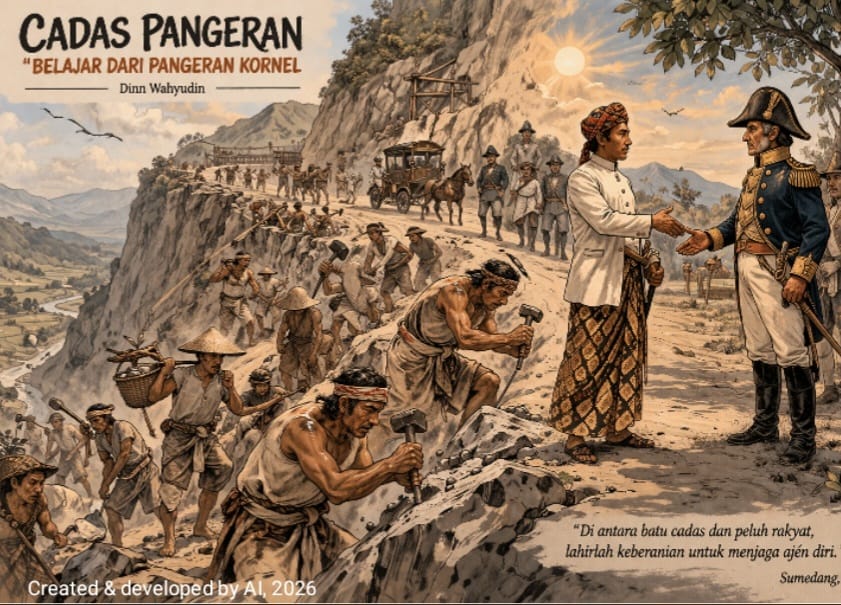
Towering steep cliffs, narrow paths carved from solid rock, and the relentless clinking of chisels and simple tools stood as silent witnesses to the forced labor imposed upon the people. Under the scorching sun and the constant threat of landslides, indigenous workers were compelled to carve a route that would connect the western and eastern parts of Java—an ambitious project paid for with immense human suffering.
This was the heroic event of Cadas Pangeran. Daendels grew increasingly frustrated as the progress of the Anyer–Panarukan road project was hindered by the unfinished section around the rocky hills of Cadas Pangeran. On the other hand, Pangeran Kornel felt deeply troubled and his dignity was shaken as he witnessed his people being treated unjustly. Thousands had perished from exhaustion, hunger, and disease during the construction.
Amid this situation stood Pangeran Kornel, the Regent of Sumedang, bearing a dual responsibility: safeguarding his people while confronting colonial pressure. He personally witnessed his people laboring tirelessly—their bodies exhausted, their faces reflecting a silent resignation, caught between obedience and coercion. The mountain winds carried dust and sighs, creating a somber atmosphere far removed from any sense of well-being.
When the meeting between Daendels and Pangeran Kornel took place, the atmosphere was extremely tense. The encounter was far from cordial, as both parties felt uneasy during the Governor-General’s visit. When Daendels extended his hand for a handshake, Pangeran Kornel responded in a manner that shocked him. The Prince shook hands using his left hand, while his right hand firmly grasped the hilt of his ancestral kris. This gesture startled Daendels and was perceived as a sign of defiance.
This heroic moment has been immortalized visually in the Cadas Pangeran area along the old Bandung–Sumedang road. It symbolizes a bold protest—a head-to-head stance by the Prince against the Governor-General, regardless of the risks involved. Even the possibility of bloodshed had been carefully considered. According to one version of the story, Daendels ultimately restrained his anger, changed his strategy, and promised to deploy Dutch engineering troops to complete the difficult section of the road in the steep and rugged terrain of Cadas Pangeran.
Love, Dignity, and Humanity
The Cadas Pangeran event is both heroic and legendary. It may serve as an enduring model of leadership for the people of Sumedang even today. From this event, which occurred more than two centuries ago, several meaningful lessons can be drawn. It demonstrates the powerful aura of a leader whose actions are grounded in deudeuh—a deep sense of love and compassion for the people—while upholding dignity and humanity.
First, the event reflects noble conduct—a leader’s readiness to defend the people with genuine love. It embodies a leadership model that upholds dignity and humanity. The Sundanese values of nyaah, deudeuh, jeung ajén diri ka rahayat (love, compassion, and respect for the dignity of the people) were symbolically expressed by Pangeran Kornel. The title “Kornel” itself is derived from “Colonel,” signifying leadership within a military system.
Second, Pangeran Kornel’s gesture of offering his left hand for a handshake represents the courage to resist injustice. This is a vital trait for all individuals, especially leaders. Leadership must be oriented toward the people—providing solutions and alternatives, rather than merely issuing orders at the expense of the people. As stated: “Be a leader with a ladder, not a boss with an order” (Mridha, 2018). A true leader builds pathways to solutions, rather than simply pointing fingers. Pangeran Kornel exemplifies a leader willing to take risks for the greater good. His leadership reflects a meeting point between local and colonial cultures, and in today’s context, represents strong local and national leadership capable of resisting external pressures.
Third, this historic event illustrates the intelligence and strategic thinking of a leader. Pangeran Kornel demonstrated courage and wisdom in responding to the challenges of his time. Among many regional leaders affected by the Great Post Road project, most complied without resistance. Yet in Sumedang, the Regent resisted. He was courageous and strategic. He defended his people and his dignity. He personally received Daendels and presented his arguments in a bold and symbolic manner. His approach ultimately softened Daendels’ harsh stance. The lesson here is clear: act wisely and strategically for the welfare of the people, guided by sincere compassion.
This is the legendary story of Cadas Pangeran. The key lesson we can draw is to become leaders who truly love and serve their people—leaders whose actions and policies are dedicated to public welfare. In the context of education, this is reflected in leadership and institutional policies built upon compassion, expressed through a pedagogy of care for students and the broader community.
Cadas Pangeran at that time was not only a matter of time and geography, but also an inner space—a site where power and humanity collided. It reminds us that development imposed without regard for human values leaves deep historical wounds. From this story, we learn that leadership is not merely about executing orders from above, but about the courage to stand among the people, to feel their suffering, and—despite limitations—to preserve shared dignity and honor.
Learning from Pangeran Kornel, true leadership arises not from power, but from moral alignment with the people. Though not recorded as a major rebel in colonial archives, his leadership lives on in collective memory as a symbol of moral courage. Even under immense and dangerous pressure, there remains a space to preserve dignity and humanity.
May the late Pangeran Kusumadinata IX, known as Pangeran Kornel, rest peacefully in Barzakh, honored in the sight of Allah SWT. We pray: Allahummaghfir lahu, warhamhu, wa‘afihi, wa‘fu ‘anhu. O Allah, forgive him, have mercy on him, grant him peace, and pardon him. Ameen. ***
Dinn Wahyudin, Professor at the Indonesia University of Education (UPI), Vice Rector I of the Indonesia Cooperative University (IKOPIN University).