By Dinn Wahyudin
OVER the past few decades, educational development in Indonesia has shown achievements that appear encouraging from a quantitative perspective. Various macro indicators—such as increased school participation rates, expanded access to education, higher graduation rates, and a growing number of highly accredited institutions—are often used as benchmarks of success. Data from Statistics Indonesia (2023) indicate that the Gross Enrollment Ratio (GER) for secondary and higher education has continued to increase over the past decade.
However, a number of critical studies suggest that these achievements do not fully reflect the true quality of learning. The World Bank (2020), in its Indonesia Education Flagship Report, emphasizes that increased access to education in Indonesia has not been accompanied by significant improvements in learning outcomes. Incontemporary educational discourse, this phenomenon is often referred to as pseudo-success.
Theoretically, this concept can be explained through the perspective of measurement-driven education, as critiqued by Campbell (1976) through Campbell’s Law. This theory highlights that when a quantitative indicator becomes the primary goal, it tends to be distorted and loses its validity as a meaningful measure. In the context of modern education, similar criticisms were raised by Ravitch (2010), who showed how standardized test-based policies in the United States encouraged “teaching to the test” without improving students’ depth of understanding. This argument is reinforced by Biggs’ (1999) theory of deep versus surface learning, which emphasizes that meaningful learning cannot be measured solely by final outcomes, but by the depth of students’ cognitive processes.
From a global empirical perspective, OECD reports through the PISA studies (2018, 2022) consistently reveal a gap between formal academic achievement and students’ literacy, numeracy, and critical thinking skills. Indonesia, for instance, still ranks below the OECD average in reading literacy and mathematics scores. These findings align with UNESCO’s (2021) Global Education Monitoring Report, which states that a learning crisis occurs when students attend school but fail to acquire basic skills—a condition often described as schooling without learning.
At the national level, various regulations have emphasized the importance of holistic educational quality. Law No. 20 of 2003 on the National Education System underscores that education aims to develop students’ full potential. In addition, the Merdeka Belajar (Freedom to Learn) policy, implemented since 2019, promotes the transformation of learning toward competency- and character-based approaches. However, an evaluation report by the SMERU Research Institute (2022) indicates that the implementation of education policies at the school level still faces challenges, particularly the dominance of administrative approaches and the lack of meaningful changes in classroom teaching practices.
Other educational research shows that factors such as teacher quality, instructional design, and learning culture have a far more significant influence on learning outcomes than mere compliance with administrative standards. Hattie’s (2009) meta-analysis in Visible Learning demonstrates that teacher-related factors have a strong effect on student achievement, particularly in feedback, clarity of instruction, and pedagogical relationships. Nevertheless, a World Bank (2015) study on teacher certification programs in Indonesia found that improvements in welfare and certification status do not automatically enhance classroom teaching quality. This indicates a gap between formal policy and actual practice at the institutional level.
Furthermore, in terms of graduate readiness, data from Statistics Indonesia (2023) show that the open unemployment rate among higher education graduates remains relatively high compared to those with secondary education. This finding is reinforced by the Asian Development Bank (2021), which highlights a skills mismatch between graduates’ competencies and labor market demands in Indonesia. This condition further confirms that indicators of success, such as institutional accreditation, do not necessarily reflect the relevance and quality of educational outcomes.
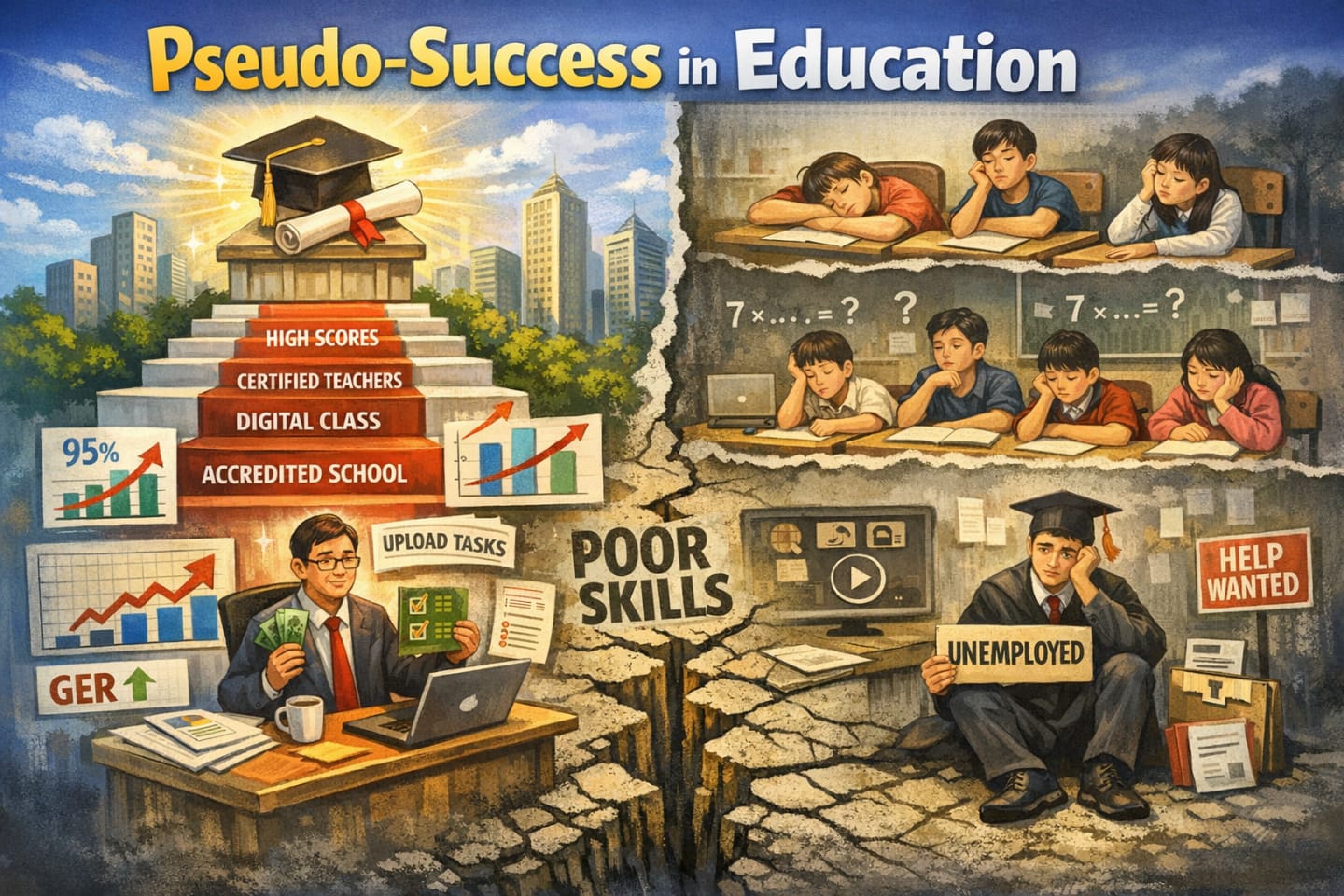
Therefore, it is essential to critically examine the phenomenon of “pseudo-success” in education—namely, conditions that appear successful based on formal indicators but do not reflect the actual quality of learning. Understanding this phenomenon is a crucial first step in formulating more authentic, evidence-based education policies and practices that are oriented toward meaningful learning and relevance to real-life challenges in the 21st century.
Examples of Pseudo-Success
There are several examples of pseudo-success in education, which can be described as follows:
First, the phenomenon of high exam scores but low literacy and numeracy.
Data show an increase in average school exam scores and graduation rates approaching 100%. However, independent assessments such as those conducted by the OECD through the Programme for International Student Assessment (PISA) reveal that students’ literacy and numeracy skills remain below the global average. This indicates a learning practice oriented toward memorization (teaching to the test), rather than deep understanding.
Empirical data reinforce this phenomenon. Findings from the Organisation for Economic Co-operation and Development (OECD) through PISA studies show that Indonesian students’ scores in reading literacy, mathematics, and science consistently fall below the average of member countries. In fact, most students remain at basic competency levels (Levels 1–2), meaning they can only understand simple information and are not yet capable of complex reasoning. In contrast, national exam and school assessment graduation rates in recent years have almost always exceeded 95%, reflecting grade inflation and assessment standards that do not fully represent actual competencies. These findings are further supported by UNESCO reports highlighting the gap between administrative educational achievements and the actual quality of classroom learning, reinforcing the argument that high exam scores do not necessarily reflect true literacy and numeracy abilities.
Second, the phenomenon of high school participation rates but low student engagement.
The Gross Enrollment Ratio (GER) and Net Enrollment Ratio (NER) have increased significantly, indicating improved access to education. However, classroom observations show that many students are passive, lack motivation, and experience learning disengagement. Physical attendance does not necessarily imply cognitive or emotional involvement in the learning process.
International data and theoretical studies support this condition. The World Bank (2020) report on learning poverty shows that despite increased school access in many developing countries, including Indonesia, more than 50% of children aged 10 are still unable to understand simple texts, indicating low levels of meaningful learning engagement. Similarly, PISA results reveal that many Indonesian students report low levels of student engagement, particularly in terms of sense of belonging and interest in learning. From a theoretical perspective, Fredricks, Blumenfeld, and Paris emphasize that student engagement includes behavioral, emotional, and cognitive dimensions; thus, physical presence without active participation, interest, and mental investment will not produce deep learning. This is further supported by John Hattie’s concept of student engagement, which positions engagement as a key factor in visible learning, where the quality of interaction and attention to learning matters more than mere access or attendance.
Third, the phenomenon of increasing teacher certification but stagnant teaching quality.
Large-scale teacher certification programs have increased the number of certified teachers. However, various studies show no significant correlation between certification and improvements in classroom teaching practices. This indicates that certification is more administrative than transformational in terms of pedagogical competence.
Several empirical studies confirm this weak correlation. World Bank research (2012), in Teacher Certification and Beyond, shows that teacher certification programs in Indonesia did not produce significant improvements in teaching practices or student learning outcomes, although they did improve teacher welfare. Similar findings were reported by the SMERU Research Institute (2019), which stated that certification functions more as an administrative mechanism and financial incentive rather than as a tool for improving pedagogical competence. Furthermore, UNESCO (2021) emphasizes that improving learning quality requires continuous professional development (CPD) based on reflective practice, rather than one-time certification. These findings suggest that without changes in professional development systems and teacher learning culture, certification tends to have limited transformational impact.
Fourth, the phenomenon of digitalization in education with minimal pedagogical transformation.
Many schools and higher education institutions have adopted digital platforms such as Learning Management Systems (LMS). However, their use is often limited to uploading materials and assignments, without innovation in teaching methods. Technology merely replaces old media rather than transforming learning (substitution rather than transformation).
Research findings indicate that this phenomenon is widespread and systemic. UNESCO (2021), in the Global Education Monitoring Report, emphasizes that digital technology adoption in many countries, including Indonesia, remains at the substitution stage, where technology is used only to digitize existing practices without changing pedagogical approaches. Similarly, OECD studies (2020) show that LMS usage in schools and universities is largely limited to content distribution and assignments, with minimal impact on learning quality unless accompanied by innovative instructional design. Theoretically, the SAMR Model developed by Ruben Puentedura explains that true pedagogical transformation occurs only at the levels of modification and redefinition, while most digital practices remain at the substitution level. This confirms that without a shift in teaching paradigms, digitalization risks becoming merely superficial modernization.
Fifth, the phenomenon of increased institutional accreditation but low graduate employability.
Many educational institutions achieve high accreditation status (A or Excellent), yet data from Statistics Indonesia show that unemployment among higher education graduates remains relatively high. This indicates a gap between administrative institutional standards and the relevance of graduates’ competencies to labor market needs.
National data and global studies reinforce this gap. Statistics Indonesia (2023) reports that the open unemployment rate among higher education graduates is still relatively high compared to those with lower levels of education, reflecting a mismatch between graduates’ skills and labor market demands. The World Economic Forum (2020), in its Future of Jobs Report, also emphasizes that many education systems have not kept pace with the evolving skill demands of the 21st century, particularly in critical thinking, creativity, and collaboration. Theoretically, the concept of employability skills proposed by Yorke and Knight (2006) highlights that job readiness is not determined solely by academic achievement or institutional accreditation, but by the integration of knowledge, skills, and personal attributes relevant to the workplace. These findings suggest that high accreditation does not necessarily reflect actual graduate readiness without adaptive curricula and strong partnerships with industry.
Concluding Remarks
The phenomenon of “pseudo-success” in education reflects a paradox between quantitative achievements and the substantive quality of learning. Formal indicators such as exam scores, participation rates, teacher certification, digitalization, and institutional accreditation may indicate administrative progress, but they do not fully represent true educational success—namely, the development of critical thinking skills, character, and students’ readiness for life.
Referring to Donald Campbell’s critique through Campbell’s Law, and supported by findings from the OECD, World Bank, and UNESCO, it can be concluded that educational reform should not focus solely on expanding access and meeting indicators. Instead, it must be directed toward authentic and meaningful learning transformation.
Therefore, a paradigm shift is needed—from measurement-driven education toward learning-driven education—placing the quality of the learning process, continuous teacher professionalism, pedagogical innovation, and relevance to 21st-century needs as top priorities. Without such fundamental changes, education risks remaining trapped in the illusion of success that appears convincing on the surface but is fragile in substance. ***
Dinn Wahyudin, Professor at the Indonesia University of Education (UPI), Vice Rector I of the Indonesia Cooperative University (IKOPIN University).